ConfiGrowth
A confidence-building reading app for children
00 / Overview
Background
ConfiGrowth is a mobile reading experience designed to help elementary-school children build confidence through interactive stories connected to real-life situations.
Problem
Children experience confidence in different ways: some struggle with social isolation, some depend on comparison and external validation, and others find it difficult to communicate their emotions. A single generic confidence exercise cannot support these different needs.
Goals
Create an engaging reading experience that helps children recognize their strengths, practice confidence-building behaviors, and communicate progress with their parents.
01 / Research
- Starting point
- Quantitative study
- Family interviews
- Confidence profiles
Starting from a personal question
The project began with concern for my ten-year-old brother. He was shy, found it difficult to make new friends at school, and gradually seemed less confident. As a psychology student interested in human-computer interaction, I wanted to explore how theory and technology could help children discover their strengths and build confidence.
The research frames fourth through sixth grade as an important period of transition. Children’s social and emotional development is changing rapidly, and their ability to form prosocial relationships, develop a sense of confidence, and express and manage emotions can influence how they experience school. The original design board references Rew et al. (2012), Raven (2002), and Chen et al. (2005) as background for this direction.
Quantitative study
I worked with a group of 15 elementary-school students in grades four through six, together with their parents, and conducted quantitative and qualitative studies online.
These scales consider aspects of self-perception including physical appearance, abilities, academic performance, moral character, and social interaction. The plotted results showed meaningful variation among participants and identified children with lower self-esteem scores. Rather than treating children as a single group, this result highlighted the need for a design that could respond to different confidence levels and support needs. The source board presents individual charts but does not provide a portfolio-ready aggregate effect size, so no additional statistic is inferred here.
Interviews with children and parents
To understand the experiences behind the scores, I conducted semi-structured interviews with six pairs of children and parents, selected from both higher and lower self-esteem groups.
The interview guide explored children’s experiences, challenges, desires, and expectations related to confidence. The parent questions examined situations in which children lacked confidence, how parents currently offered support, how school environments affected children, and what parents would want from a confidence-building app. Comparing the two perspectives helped reveal not only how children felt, but also where their needs and their parents’ observations aligned or differed.
Three confidence profiles
Together, these profiles revealed three connected design opportunities: build confidence through supportive social experiences, help children identify strengths without constant comparison, and give children and parents better ways to discuss emotional growth.
02 / Define
- Product direction
- Design goals
- Product loop
Product direction
I chose to design a reading app that helps children build confidence through stories grounded in real-life scenarios and presented in a playful, cartoon-based style. The product direction narrowed the earlier brainstorm into three goals:
These goals connect the research profiles to a single product loop: read a confidence-related story, make choices, practice a related behavior, and reflect on progress.
03 / Ideate
- Concept exploration
- Core direction
- Theoretical foundations
Concept exploration
Story adventures became the core because they could combine emotional learning, decision-making, rewards, and real-life practice without reducing confidence-building to a single motivational message.
Theoretical foundations
The concept was informed by four ideas documented in the original design process:
- NarrativeEngaging stories and metaphors can hold attention, support imagination, and communicate complex ideas through personal growth.
- MetaphorFamiliar images can make abstract ideas such as self-compassion and self-integrity easier to understand.
- Embodied thinkingPhysical sensations and real-world actions can help connect an idea to lived experience.
- Conceptual Metaphor TheoryRelating an abstract concept to a more concrete experience can support understanding and reflection.
04 / Prototype
- Early sketches
- Visual system
- High-fidelity overview
- User flow
Early sketches
I created rough hand-drawn sketches to explore the app’s information structure, navigation, reading screens, task flow, profile, and reward logic. The sketches served as a foundation for the higher-fidelity prototype rather than locking the concept into an early layout.
Visual system
Prototype & User Flow
The final flow follows Emily through ten connected moments:
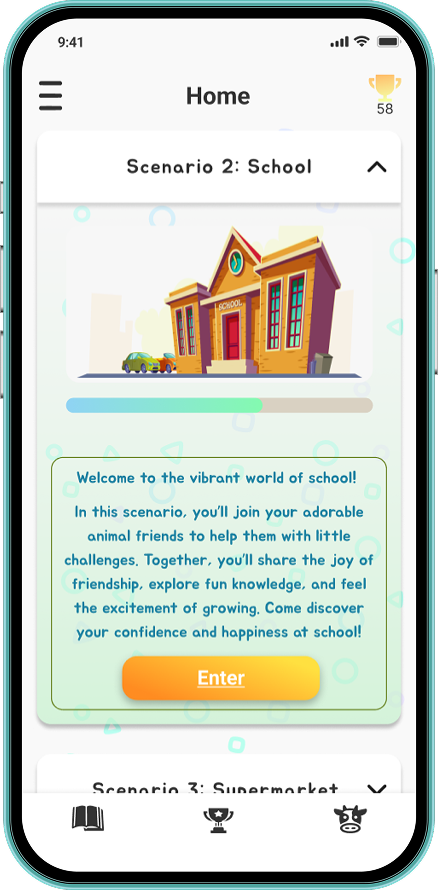
Emily browses story scenarios on the Home page, such as school, home, or the supermarket.
05 / Validate
- Family feedback
- Limitations
- Next steps
- Evidence boundary
Feedback
Families responded positively to the vibrant colors, the use of storytelling to support confidence, and interactive features such as customized avatars. These elements helped children engage with the concept.
The testing also revealed limitations. The participant group was small and may not represent a wider audience. Some features still lacked coherence, the overall experience required further refinement, and parent engagement was not yet sufficiently resolved.
Next steps
The next iteration should expand the interview group, test the story-to-task flow with more families, clarify how parent feedback supports rather than pressures children, and refine the feature set into a more consistent experience.
Evidence boundary: The source material does not provide participant counts for this final testing round, task-level usability data, or a documented follow-up study. These observations are presented as early qualitative feedback rather than validated product outcomes.