Tasty Box
An all-in-one smart service WeChat mini program for Lvdong Box.
00 / Overview
Background
Lvdong Box is an open-air commercial hub in Tianjin with restaurants, snack stalls, events, and a distinctive night-time identity. This project began as a qualitative study of the commercial area around my university and developed into a WeChat mini program concept.
Problem
Despite its appealing food and events, Lvdong Box faced low and inconsistent foot traffic. Customers had difficulty reaching the site, finding shops, evaluating unfamiliar offerings, and using on-site services; merchants faced high rent and uneven customer flow.
Goals
Make discovery, visits, ordering, and on-site services easier for customers while giving shops better visibility through a connected mini program.
01 / Research
- Field context
- Stakeholder interviews
- Customer profiles
- Competitive context
From a place I knew to a design question
A qualitative research course prompted us to study the commercial area around campus. Lvdong Box stood out as a government-developed hub with diverse food offerings, trend-led design, pop-up events, and modern amenities—but it struggled with low foot traffic and sustainable growth.
Lvdong Box
Interviews across the hub
Our four-person team spoke with government departments and site operators, interviewed 10 shop owners, and gathered feedback from 15 customers. Government representatives emphasized land revitalization; operators balanced promotion and merchant needs; merchants reported high rent and inconsistent traffic; visitors described inconvenient access, limited seating, and insufficient event variety.
Field research & interviews
Three customer profiles
The 15 interviews were synthesized into three research personas: six students, three office workers, and six parents with children.
Competitive context
I compared Lvdong Box with Wuyue Shopping Mall, Xinhua City Square, and Yongwang Square across customer groups, pricing, facilities, traffic, and events. Lvdong Box offered a distinctive open-air snack-street experience, but the malls had stronger facilities and steadier traffic.
02 / Define
- Stakeholder relationships
- Design opportunity
- Experience barriers
Stakeholder relationships
Mapping government departments, operators, third-party platforms, staff, merchants, and customers clarified which service dependencies a digital product could address. Policy and infrastructure remained outside scope; shop information, discovery, ordering, reviews, and selected on-site services did not.
Design opportunity
Three connected barriers emerged: access and orientation, confidence in a choice, and continuity of service. The concept therefore needed to connect discovery, reliable shop information, online ordering, and practical services into one visit journey—not function as a food directory alone.
03 / Ideate
- Pain points to features
- Task flow
- Product structure
From pain points to features
Parking search and transport schedules respond to access problems; Discover supports wayfinding and food choice; shop profiles reduce uncertainty; seat service connects visitors with staff; online ordering and tracking keep the journey continuous.
Task flow
The flow connects shop discovery, service access, ordering, payment, and post-visit review. It helped organize the mini program into three primary destinations—Discover, Service, and Me—without breaking the visit into separate products.
04 / Prototype
- Wireframes
- Visual system
- High-fidelity experience
- Across screens
Wireframes & information structure
The early wireframes explored Discover, Service, and Me, then clarified how a visitor could move from finding a place to completing a task without switching products.
Visual system
Purple echoes Lvdong Box’s neon night identity and fashion-forward positioning. Roboto carries the primary UI hierarchy, while Poppins adds a display accent.
High-fidelity mobile experience
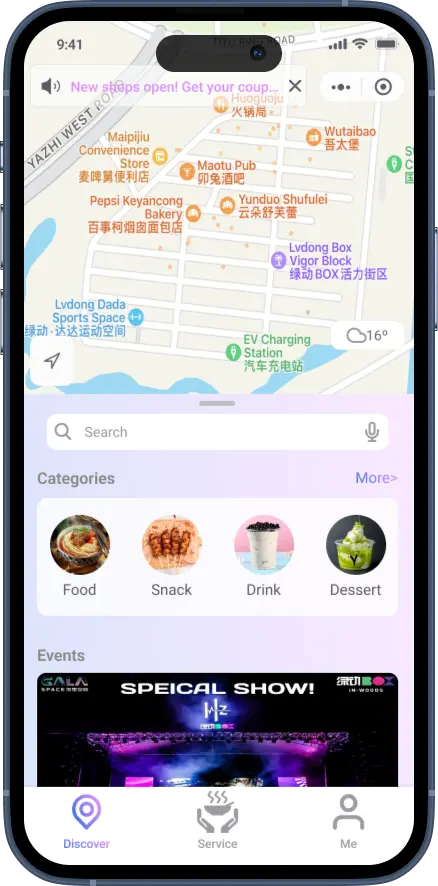
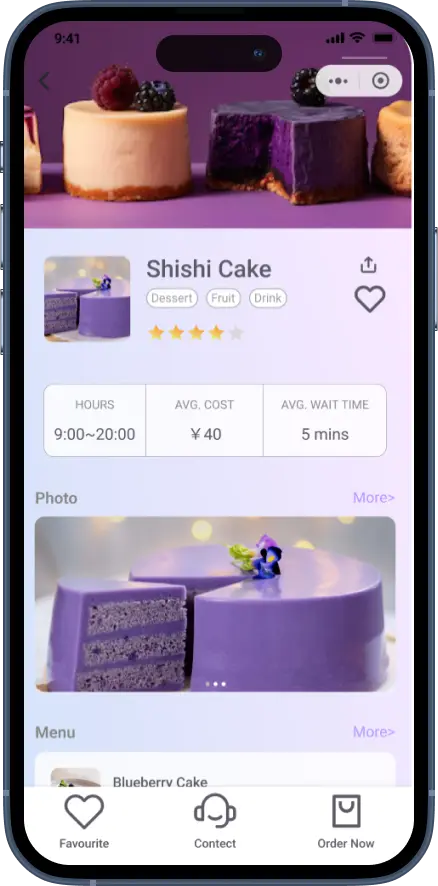
The final mobile flow connects discovery, shop comparison, ordering, on-site services, parking, profile management, and review. The phone shell stays fixed while long screens scroll vertically. Use the arrows or keyboard to move between screens.
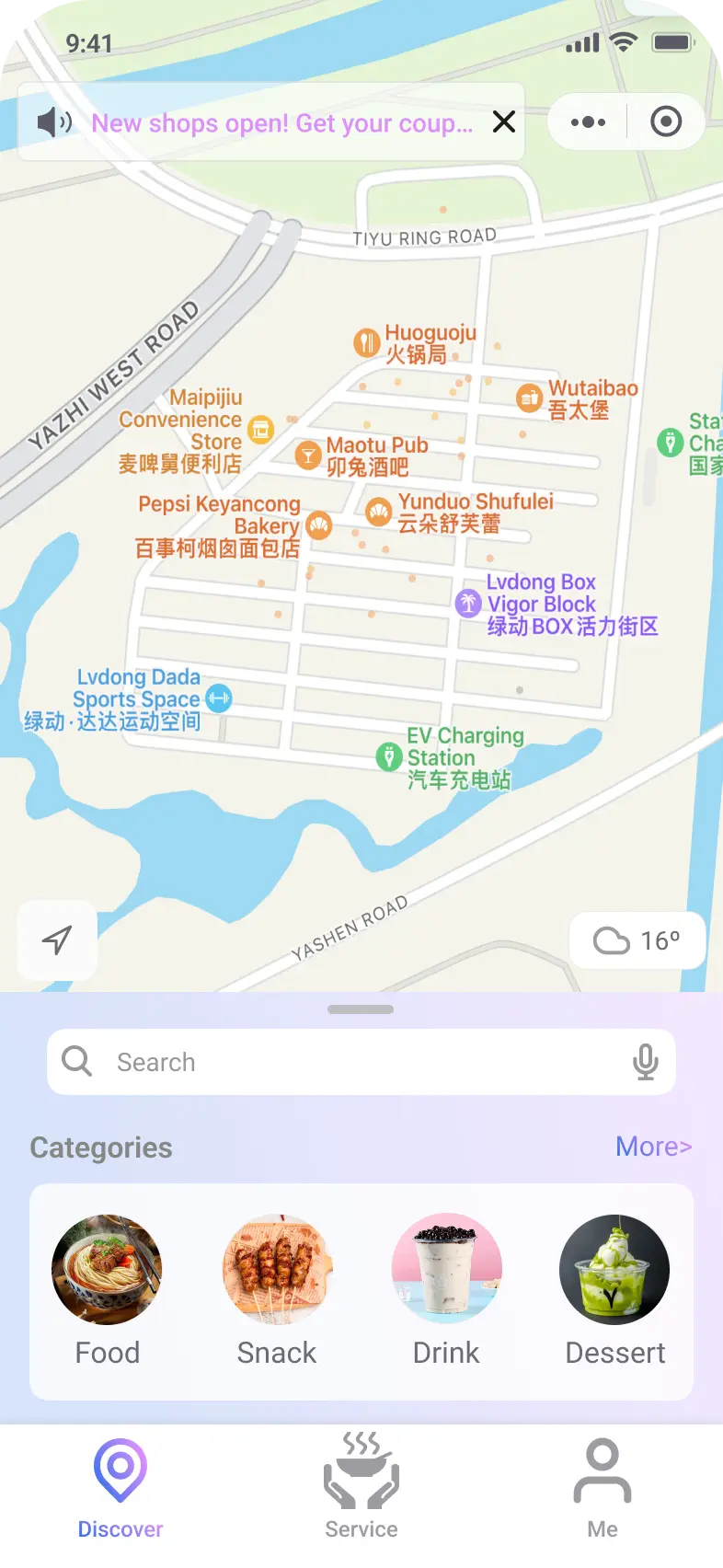
01 / 21Discover map
Across screens
After the mobile experience, I extended the system to PC and smartwatch interfaces. Each viewer preserves the supplied screens and their original proportions.
PC interface
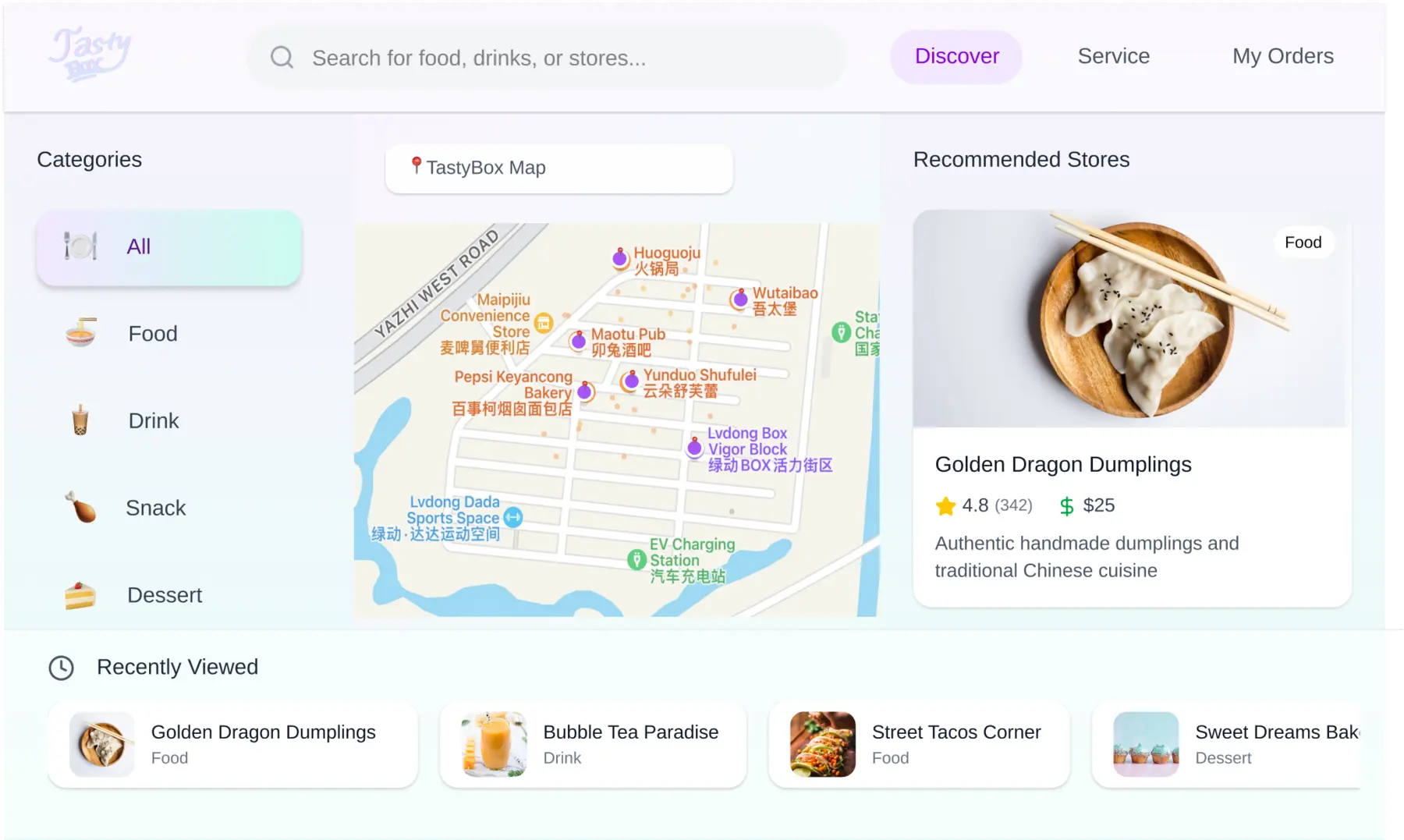
01 / 09PC interface 1
Smartwatch interface
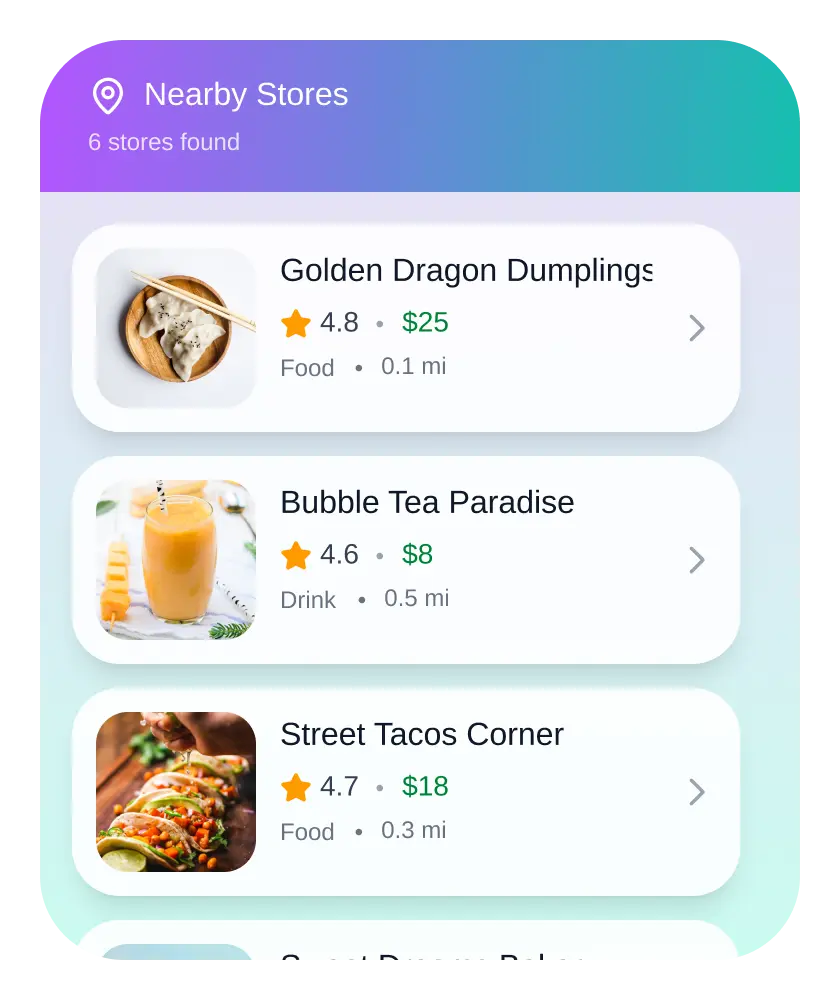
01 / 06Nearby stores
05 / Outcome
- Future direction
- Personal reflection
Future direction
This project concludes the initial research and design phase. As the concept has not yet been evaluated with real users, the next step is to test it with customers and shop owners, identify usability gaps, and refine the experience around real-world feedback.
Personal reflection
Tasty Box helped me understand how digital products can support the experience of a physical urban space. It also strengthened my ability to translate research into a multifunctional service while balancing user experience, stakeholder needs, and service integration.